The U.S. Army Corps of Engineers (USACE) holds significant authority in regulating shoreline use and structures, including private docks, on many of the lakes and waterways across our service areas, such as Lake Sidney Lanier, Lake Allatoona, Lake Hartwell, Lake Blue Ridge, and Lake Nottely. This authority stems from federal laws like the Rivers and Harbors Act of 1899 and the Clean Water Act, alongside specific regulations outlined in 36 CFR Part 327. Our primary goal, and that of the Corps, is to strike a balance between providing recreational opportunities, protecting vital environmental resources, and ensuring safe navigation for all users.
Built to last since 1956
Partner with Martin Docks for custom docks, shoreline solutions, and expert craftsmanship designed around your lakefront lifestyle.
Get An EstimateThe legal framework for shoreline management is robust, with Congress delegating authority to the Corps to manage these public resources. A cornerstone of this authority is 36 CFR Part 327.30, which establishes the Shoreline Management Program. This program is implemented at the project level through specific Shoreline Management Plans (SMPs). These SMPs are critical documents that outline policies and guidelines for protecting and managing the shoreline under Corps jurisdiction, promoting safe and healthy public use while safeguarding environmental quality.
Under Section 10 of the Rivers and Harbors Act, the Corps regulates any work in, over, or under navigable waters. Additionally, Section 404 of the Clean Water Act gives them authority over the discharge of dredged or fill material. When you apply for a dock permit, the Corps is essentially evaluating how your private structure impacts the public’s right to safe navigation and the health of the aquatic ecosystem.
SMPs are not static; they are reviewed at least every five years, with public involvement being a crucial part of any update process. This ensures that the plans remain relevant and responsive to both environmental needs and community input. Within these plans, shorelines are often categorized into different zoning classifications:
For more detailed information, the Corps provides extensive resources, including a Shoreline Management Program: Frequently Asked Questions page.
In our region, several Corps-managed lakes have their own specific Shoreline Management Plans and regulations that we at Martin Docks are intimately familiar with.
Beyond these project-specific plans, the Corps also issues Regional General Permits (RGPs) that can authorize certain activities across broader geographical areas. For instance, Regional General Permit 84 is relevant for construction, maintenance, and modification of recreational dock facilities in specific non-tidal navigable waters within Georgia. We understand how these various layers of regulation apply to your specific lakefront property.
Understanding who is eligible and how to apply for a Corps dock permit is the first critical step in your dock project. The Corps aims to ensure that private use of public lands is managed responsibly, granting permits only to those who meet specific criteria and follow a structured application process. This process is designed to protect the public interest while allowing adjacent homeowners to enjoy the water.
Generally, eligibility for a shoreline use permit or dock permit is limited to individuals who own property adjacent to public lands that are zoned for “Limited Development.” This means your property must be directly next to the public land, and you must have legal access to that public land. If there is a strip of land between your property and the water that is owned by the government, you must have the appropriate permissions to cross it.
For those on Lake Lanier, the initial step involves contacting the Corps of Engineers Lake Lanier Operation Management Office at (770) 945-9531. We highly recommend requesting an appointment with a ranger. This initial meeting is particularly important for those planning new facilities, as it allows for direct consultation and clarification of requirements specific to your location. The ranger will often conduct a site visit to determine if the shoreline can support a dock based on water depth, spacing from other docks, and environmental factors.
The application process is thorough and requires careful attention to detail. To apply for a Shoreline Use Permit, you’ll need to submit a comprehensive package that includes:
Submitting a complete application package is crucial to avoid delays. Once received, the Corps will evaluate and process your application, which typically takes approximately 6 to 8 weeks. This timeframe allows for internal reviews and, in some cases, public notices or environmental assessments.
Permits are issued for a maximum of five years and are nontransferable. This is a common point of confusion: if you sell your property, the permit does not automatically transfer to the new owner. The new owner must apply for their own permit within a specified timeframe (usually 14 to 30 days) to keep the structure legal. We at Martin Docks can guide you through preparing this detailed application, ensuring all necessary information is included and properly presented to the Corps.
The Corps of Engineers sets stringent design and construction standards for docks to ensure safety, environmental protection, and compatibility with the natural beauty and public use of the waterways. These standards cover everything from the overall size and configuration to the materials used and how the dock is anchored.
The Corps authorizes various types of facilities, including floating docks, boat shelters, walkways, electrical and water lines, steps, and shoreline protection. However, specific size limitations apply to maintain balance and prevent overdevelopment. For instance, on Lake Sidney Lanier, the maximum permissible size for an individual boat dock is 260 square feet, excluding the slip area. The maximum allowable boat shelter size is 720 square feet.
Walkways also have specific requirements, often limited in length and width. For example, some regulations specify walkway widths between 4 and 6 feet, with the total length of the facility (dock and walkway) not exceeding 80 feet from a specified elevation (e.g., 635′ NGVD). Community docks may have different limits, such as a maximum of 10 slips, and are typically permitted to homeowners’ associations. Even personal watercraft (PWC) ports and boat lifts count towards the total square footage, depending on their attachment method.
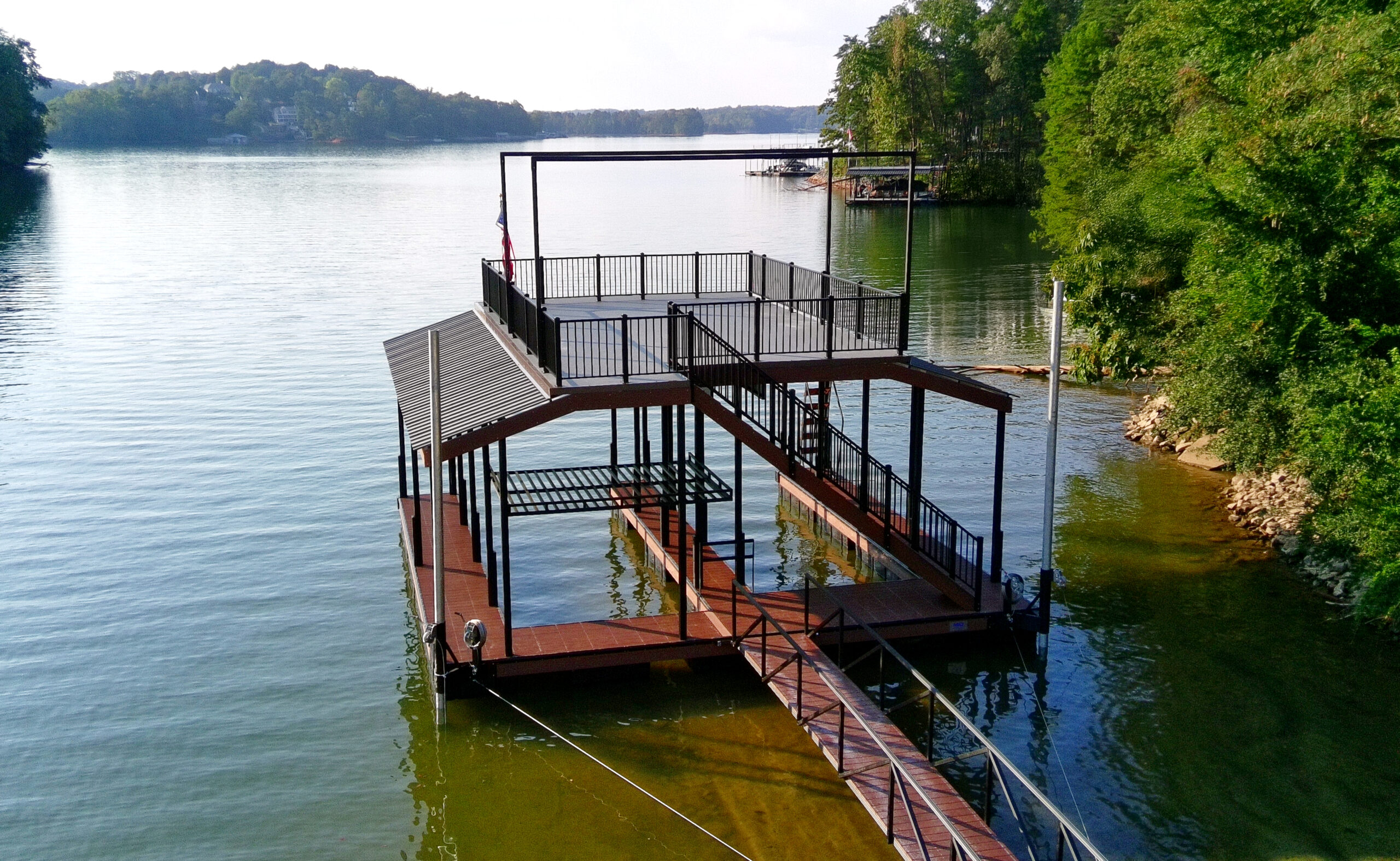
At Martin Docks, we specialize in custom aluminum floating boat docks designed to meet these specific size and configuration requirements. Our expertise ensures your dock is not only functional and aesthetically pleasing but also fully compliant with Corps regulations.
The choice of construction materials and safety features is heavily regulated to ensure durability, environmental safety, and structural integrity. The Corps prohibits materials that could break apart and litter the lake or leach harmful chemicals into the water.
Built to last since 1956
Partner with Martin Docks for custom docks, shoreline solutions, and expert craftsmanship designed around your lakefront lifestyle.
Get An Estimate
| Feature | Approved Materials/Practices | Prohibited Materials/Practices |
|---|---|---|
| Flotation | Encapsulated foam, marine-grade, 8+ year warranty | Unencapsulated foam, reused plastic/metal drums |
| Hardware | Galvanized steel, stainless steel | Non-galvanized nails, standard steel bolts |
| Decking | Pressure-treated wood, composite, aluminum | Untreated lumber, materials prone to splintering |
| Electrical | Certified by registered electrician, NEC compliant | DIY wiring, non-marine rated components |
| Anchoring | Steel cables, stiff arms, lake-bottom posts | Ropes, concrete blocks that damage the bed |
Beyond the structure itself, the Corps regulates where the dock sits. Most projects require a minimum water depth (often 4 feet) to ensure the dock does not rest on the lake bottom during normal fluctuations, which can damage the benthic environment. Additionally, docks must maintain a minimum spacing from neighboring structures—often 50 feet—to ensure safe navigation and prevent the shoreline from becoming overcrowded. These rules ensure that the center of coves and channels remains open for public use.