
What Is Riprap Design and Why Your Shoreline Depends on It
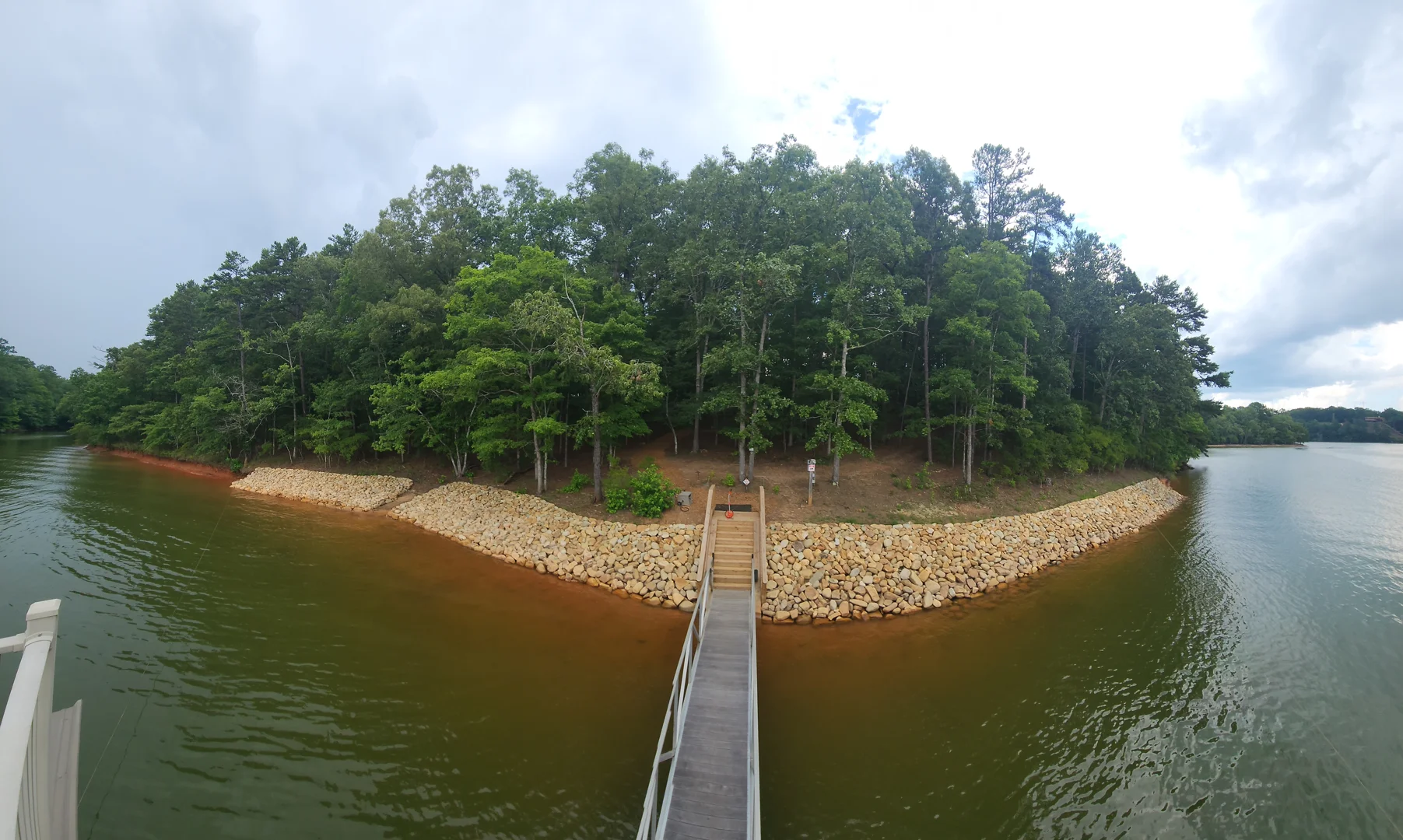
Riprap design is the engineering process of selecting, sizing, and placing large, angular stones to protect shorelines, streambanks, and slopes from erosion caused by wave action, flowing water, and runoff.
Here’s a quick overview of what good riprap design involves:
| Design Element | Key Requirement |
|---|---|
| Stone size (D50) | Based on flow velocity, wave height, and slope |
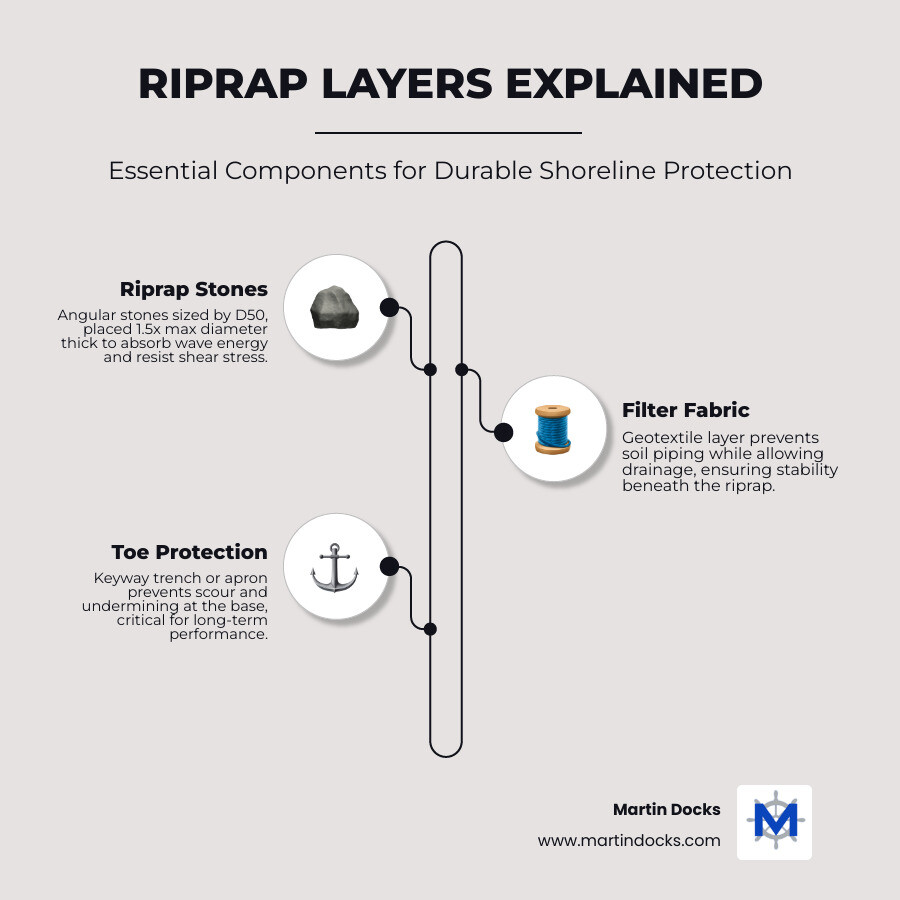
| Layer thickness | At least 1.5x the maximum stone diameter |
| Bank slope | No steeper than 2H:1V (2 horizontal : 1 vertical) |
| Filter layer | Geotextile fabric or gravel to prevent soil loss |
| Toe protection | Keyway trench or apron to prevent undermining |
| Freeboard | Typically 0.6 m (2 ft) above design water level |
If you own waterfront property on a lake like Lake Lanier, you’ve probably seen what happens without proper protection. Boat wakes, fluctuating water levels, and storm runoff quietly eat away at unprotected banks — year after year — until you’re left with collapsed slopes, exposed roots, and a shrinking shoreline.
Riprap is one of the most widely used and reliable solutions for this problem. It works by absorbing and deflecting wave energy, armoring the soil surface, and allowing water to drain freely without washing soil away underneath.
But riprap only works when it’s designed correctly. The wrong stone size, a missing filter layer, or a toe that isn’t protected can cause the whole installation to fail — often quickly and expensively.
This guide walks you through everything you need to know: from stone sizing and gradation to construction practices, filter layers, and maintenance.
Core Principles of Riprap Design
At its heart, riprap design is about balance. We are balancing the destructive forces of water—whether it’s a rushing stream or a crashing wave from a passing wake—against the weight and friction of the stones. If the water’s force is greater than the stone’s resistance, the stone moves, and the bank begins to fail.
When we look at a project on Lake Lanier or Lake Nottely, we have to consider several hydraulic factors. One of the most important resources we use for these calculations is the Design of Riprap Revetment HEC-11, which provides the technical framework for ensuring stone stability.
The design process starts by analyzing three main factors:
- Flow Velocity: How fast is the water moving? In channels or near culvert outlets, this is the primary concern.
- Wave Height: On lakes, boat wakes and wind-driven waves are the biggest threats.
- Fetch Length: This is the unobstructed distance over which wind blows across the water. For many small reservoirs, we follow procedures limited to an effective fetch of less than 10 miles and significant wave heights under 5 feet.
Determining Stone Size in Riprap Design
One of the most common questions we get is, “How big do the rocks need to be?” In riprap design, we talk about the D50 median stone size. This doesn’t mean every rock is the same size; it means that 50% of the stones in the mix (by weight) are smaller than this diameter.
To find the right D50, we look at tractive force and shear stress. These are fancy ways of describing the “push” the water exerts on the rocks. We often use the Isbash equation, a tried-and-true formula that relates stone size to water velocity. For example, a water velocity of 5 feet per second (fps) might only require 6-inch stones, but a velocity of 15 fps—common in high-flow storm situations—could require massive 36-inch boulders.
Optimizing Gradation for Riprap Design
You might think that using perfectly uniform stones would look the best, but in riprap design, “well-graded” is the gold standard. A well-graded mix includes a variety of stone sizes. This is crucial because the smaller stones fill the gaps between the larger ones, creating a dense, interlocking mat.
This interlocking action is what gives riprap its “self-healing” property. If a single stone settles or shifts, the surrounding stones naturally adjust to fill the void, maintaining the integrity of the barrier. A good rule of thumb for the uniformity ratio is keeping the D85/D15 ratio around 2.0. This ensures the mix isn’t too uniform (which allows water to whistle through the gaps) or too varied (which can lead to the smaller stones washing away).
Slope and Alignment Considerations
The angle of your bank is perhaps the most critical physical constraint. For most dumped riprap installations, the design slope should not be steeper than 2H:1V (two feet of horizontal distance for every one foot of vertical rise). If you go steeper than this, gravity starts to work against you, and the stones are much more likely to slump or slide down the bank.
We also have to consider the longitudinal extent—how far up and down the shoreline the protection needs to go—and the freeboard requirements. In our region, including North Georgia and Western North Carolina, we typically design for a freeboard of 0.6 meters (about 2 feet) above the high-water mark. This accounts for wave run-up, debris, and those unexpected high-water events that characterize our local lakes.
Material Specifications and Filter Layers
Not all rocks are created equal. When we specify materials for riprap design, we aren’t just looking for “heavy things.” We need stones that can survive the elements for decades.
Rock Quality and Durability
In North Georgia, we have to deal with the freeze-thaw cycle. If a rock is porous and absorbs water, that water will expand when it freezes, eventually cracking the stone into useless rubble. We look for stones with:
- High Specific Gravity: Typically 2.5 or higher.
- Low Absorption: Less than 2%.
- Durability: Stones must pass tests like the LA Abrasion test (to ensure they don’t wear down) and sulfate soundness tests (to ensure they don’t chemically degrade).
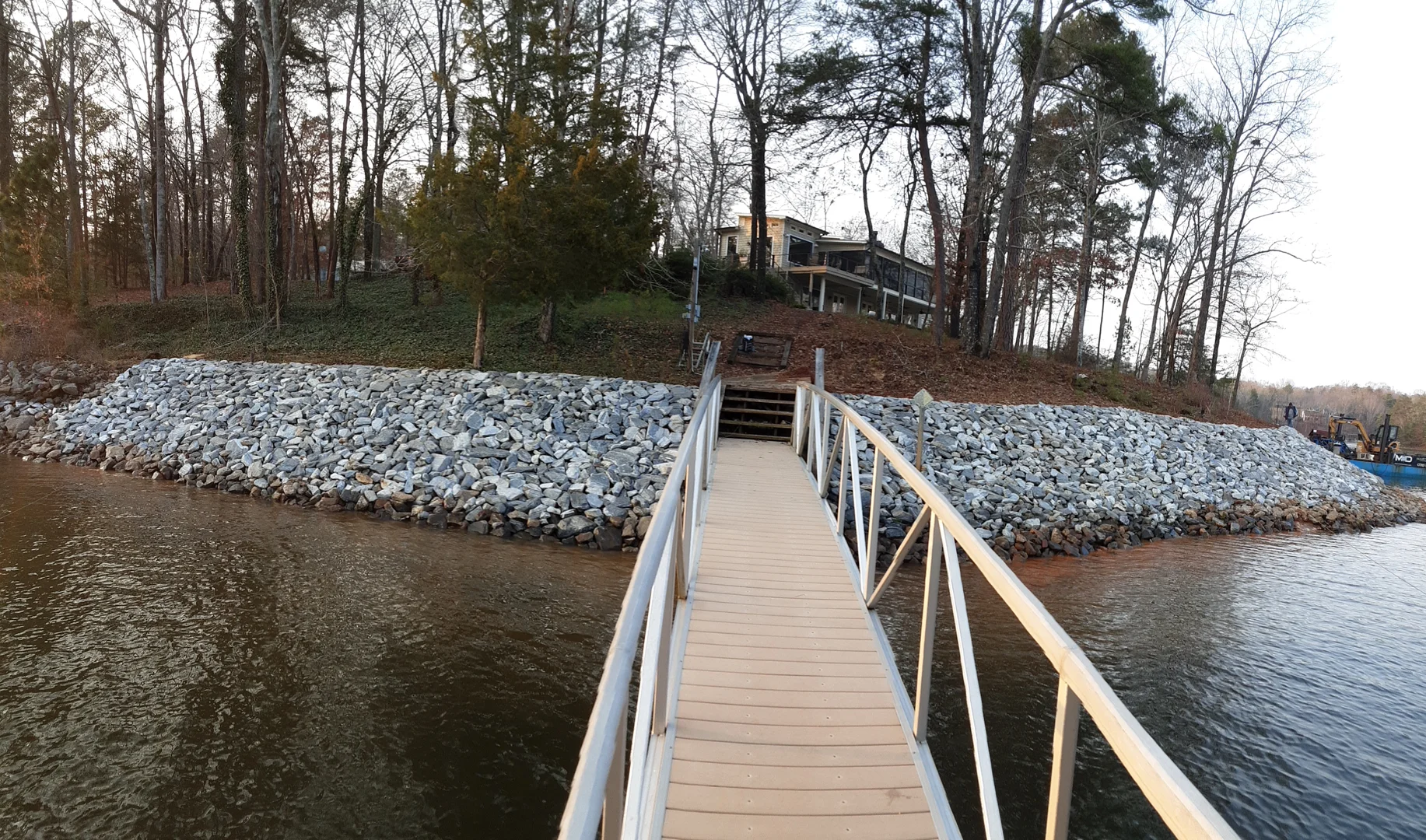
Granite is our go-to material in the Gainesville and Hiawassee areas. It’s incredibly hard, heavy, and has the jagged, angular shape required for interlocking stability. Avoid rounded river rocks for high-energy areas; while they look nice, they tend to roll like marbles when hit by heavy waves.
For more detailed technical specs on stone classifications, you can refer to Section 7E-10 – Rip Rap.
Geotextile and Granular Filters
This is the most overlooked part of riprap design, but arguably the most important. If you place heavy rocks directly onto red clay or sandy soil, the water will eventually suck the soil out through the cracks between the rocks. This is called soil piping.
To prevent this, we install a filter layer. There are two main types:
- Geotextile Filters: This is a heavy-duty, non-woven fabric (usually 8-12 oz) that acts like a coffee filter. It lets water move through freely but keeps the soil particles where they belong. We recommend an overlap of at least 12 inches at the seams.
- Granular Filters: This is a 6-inch layer of sand or small gravel. While effective, it’s often harder to install on steep slopes than fabric.
Without a filter, the rocks will eventually sink into the mud, and the bank will collapse behind them. If you are planning a project that involves more than just a simple bank—like a path to the water—you might want to check out More info about riprap stair installation to see how we integrate access with protection.
Step-by-Step Riprap Construction Practices
Once the riprap design is finalized, it’s time to move some dirt. Proper construction is what separates a professional job from a weekend DIY project that washes away in the first storm.
Site Preparation and Keyway Excavation
We start by clearing the area of large debris, stumps, and loose brush. The subgrade is then excavated and compacted. But the “secret sauce” of a stable revetment is the toe protection.
We dig a keyway trench at the very bottom of the slope, where the land meets the lake bed. This trench should be at least 1.5 times the thickness of the riprap layer. We fill this trench with the largest stones in the mix. This acts as an anchor, preventing the entire wall of rock from sliding down into the lake (a failure known as a translational slide) and protecting against toe scour caused by underwater currents.
Placement and Quality Control
When it comes to putting the rocks in place, we prefer bucket placement over end-dumping. If you just dump a truckload of rocks down a hill, the big ones roll to the bottom and the small ones stay at the top. This is called segregation, and it ruins your gradation.
Using an excavator with a hydraulic “thumb” allows us to place the stones precisely, ensuring the thickness is consistent—usually at least 1.5 times the D50 or the maximum stone diameter. We start at the bottom (the toe) and work our way up. We also take care not to drop the rocks from more than a foot or two, especially if we’re placing them on geotextile fabric, to avoid punctures.
While we’re on-site, we often find that customers need other repairs to their waterfront infrastructure. If your dock has taken a beating from the same waves that eroded your bank, you can find More info about dock repair services to get everything back in tip-top shape.
Preventing Common Failure Modes in Riprap Design
Even the best-laid plans can go awry if you don’t account for how riprap fails. Understanding these failure modes helps us build better systems from the start.
Common Failure Modes
- Particle Erosion: The water is moving faster than the rocks can handle. This usually happens when the D50 was undersized during the riprap design phase.
- Toe Scour: The lake bed at the base of the rocks washes away, causing the rocks to fall into the hole and the rest of the slope to slump.
- Translational Slide: The entire layer of rock slides down the bank as a single unit. This often happens on slopes that are too steep or when the filter fabric is too slick.
- Soil Piping: As mentioned, this is when the soil “leaks” out from behind the rocks because a filter layer was missing or damaged.
Environmental and Regulatory Compliance
You can’t just start dumping rocks into Lake Lanier or Lake Chatuge. Most riprap projects require permits from the U.S. Army Corps of Engineers and often the Department of Natural Resources (DNR).
These agencies look at:
- Fisheries Windows: There are certain times of the year (usually during spawning) when you cannot do instream construction.
- Habitat Mitigation: Sometimes we need to include “eco-pockets” or scalloped shorelines to provide habitat for local fish and wildlife.
- Property Lines: Ensuring the protection doesn’t negatively impact your neighbor’s shoreline.
Navigating these regulations is a big part of what we do. Getting caught without a permit can lead to massive fines and a requirement to remove all the work you just paid for.
Maintenance and Post-Flood Inspection
Riprap is “low maintenance,” not “no maintenance.” We recommend an annual inspection and a quick check after every major storm or flood event.
Look for:
- Displaced Stones: If you see “bald spots” in the rock layer, they need to be patched immediately.
- Vegetation: While some grass is fine, large woody brush or trees can actually destabilize the riprap. Their roots can push rocks out of place, and if a tree blows over, it can take a huge chunk of your revetment with it.
- Sediment Buildup: Excessive silt can clog the drainage properties of the riprap.
For those who want extra peace of mind for their entire waterfront setup, including their dock, we offer monitoring solutions. You can find More info about dock monitoring to see how we keep an eye on things when you aren’t there.
Frequently Asked Questions about Riprap
What is the minimum thickness for a riprap layer?
A standard rule in riprap design is that the layer should be at least 1.5 times the maximum stone diameter or the D100 size. In practical terms for residential lakefronts, this usually means a minimum thickness of 12 to 18 inches. If the rocks are placed underwater, we often increase that thickness by 50% to account for the difficulty of precise placement.
When should I use a filter fabric under the rocks?
Almost always. Unless you are placing riprap over a very specific type of well-graded gravelly soil that already acts as a natural filter, you need a geotextile. On the red clay banks common in Georgia and South Carolina, fabric is non-negotiable to prevent soil piping and the eventual “sinking” of your rocks.
Can riprap be used on very steep slopes?
Standard dumped riprap is generally limited to a 2H:1V slope. If your bank is steeper than that, you have to look at alternative (and usually more expensive) options like grouted riprap (where concrete is poured into the gaps) or gabions (rocks held in wire baskets). These methods provide the structural stability that loose rock simply can’t offer on a cliff-like face.
Conclusion
Protecting your shoreline is an investment in your property’s future. A well-executed riprap design doesn’t just stop erosion; it preserves your land, protects the local water quality by reducing siltation, and can even add a rugged, natural beauty to your waterfront.
At Martin Docks, we’ve been serving the lakes of North Georgia and the surrounding regions since 1956. We understand the specific challenges of our local red clay, the power of Lake Lanier’s boat wakes, and the regulatory hurdles of the Army Corps. Whether you’re looking to armor a small cove or stabilize a major embankment, we bring generations of experience to every stone we place.
Ready to secure your shoreline? You can find More info about our shoreline and dock services and let us help you build something that lasts for decades to come. Don’t let your property wash away—give us a call and let’s get your shoreline “rock solid.”