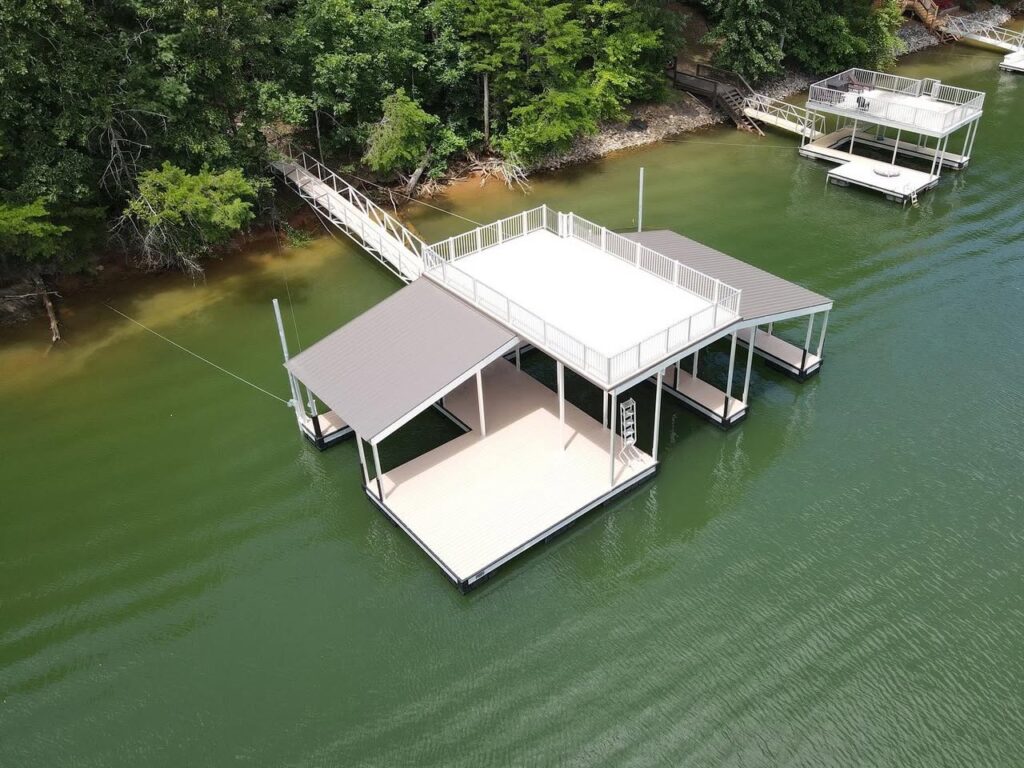
Dock repair on Lake Lanier is one of the most common — and most overlooked — needs for waterfront property owners on one of Georgia's most popular lakes.
Here are the 7 signs your dock needs professional repair:
Lake Lanier isn't like most lakes. Water levels can swing dramatically — sometimes by several feet — due to seasonal droughts, reservoir management, and heavy rainfall. That constant movement puts enormous stress on every part of your dock system, from the pilings to the floats to the cables.
Small problems get expensive fast. A frayed cable or a cracked float might seem minor today. Left alone, it can lead to a fully displaced dock, a safety hazard, or a costly full replacement.
Martin Docks has been serving Lake Lanier homeowners since 1956. In that time, the team has seen every type of dock damage this lake can dish out — and the pattern is almost always the same: the warning signs were there long before the real damage happened.
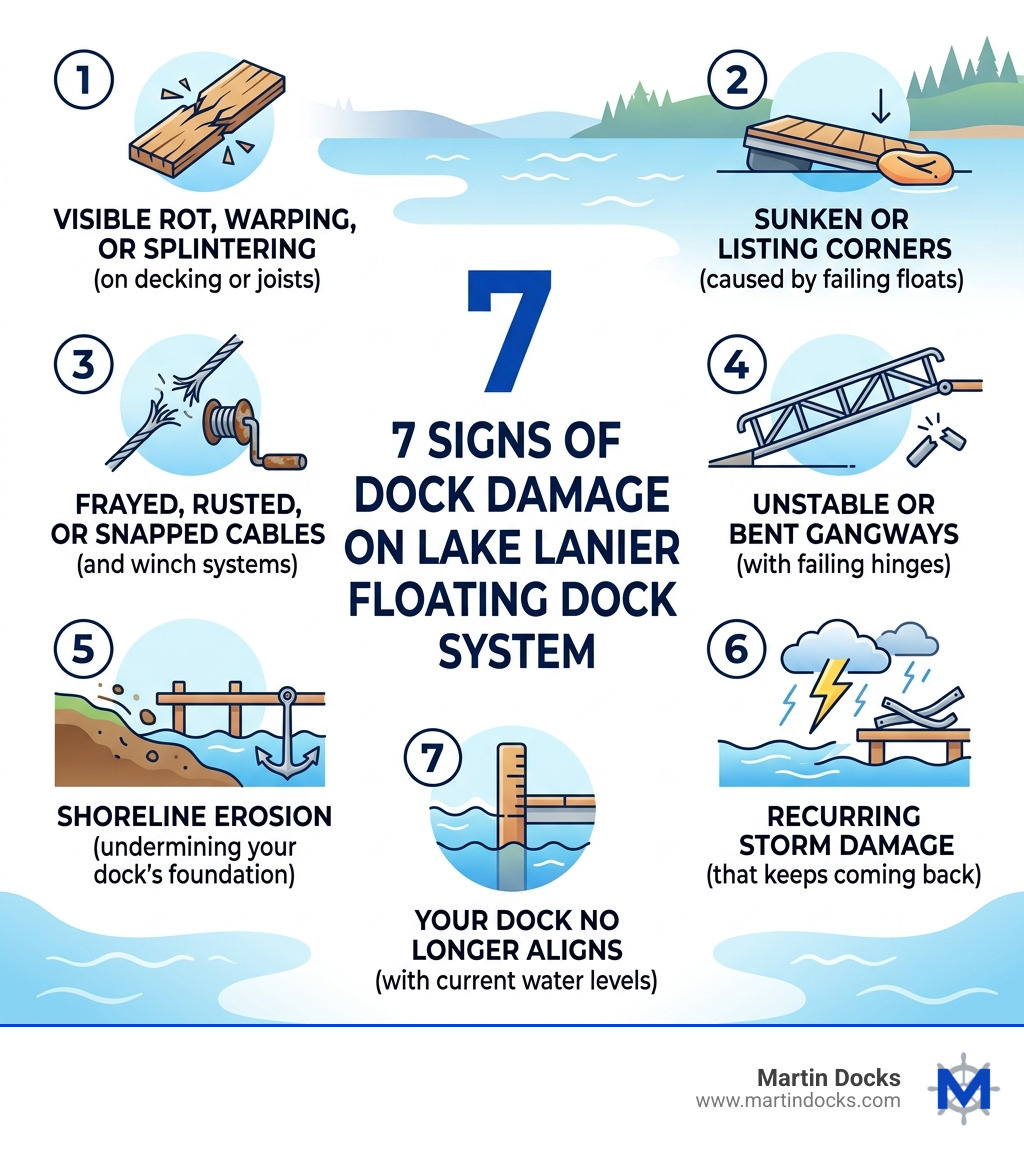
One of the most obvious indicators that you need Dock Repair on Lake Lanier is the physical deterioration of the surfaces you walk on every day. Because Lake Lanier is located in North Georgia, our docks are subjected to intense UV exposure during the summer and damp, freezing conditions in the winter. This cycle causes wood to expand and contract, eventually leading to splintered decking and warped planks.
Structural decay isn't just an eyesore; it's a major safety liability. If you notice "soft spots" while walking or see that your joists are beginning to sag, the integrity of the entire platform is at risk. Rotting wood can harbor mold and mildew, which further accelerates the breakdown of the fiber. Furthermore, rusted hardware -- like screws that have popped up or brackets that are flaking away -- indicates that the "skeleton" of your dock is losing its grip.

When we look at structural fixes, we focus on longevity. For many older docks on Lake Lanier, the transition from traditional wood to marine-grade materials is a game-changer. We often utilize galvanized steel and saltwater-grade fasteners to ensure that the connections holding your dock together don't succumb to the constant moisture.
If your pilings are showing signs of "necking" (thinning at the water line) or rot, they must be reinforced or replaced immediately. Using pressure-treated lumber that is specifically rated for ground and water contact is essential. For those looking for a lower-maintenance future, we often recommend decking and structural repairs that incorporate composite materials like Trex, which resist UV damage and rot much better than traditional pine. You can learn more about how we handle these professional dock repair insights from Martin Docks to keep your waterfront safe.
Does your dock feel like a seesaw when you step onto it? Or perhaps one corner sits noticeably lower in the water than the others? This is known as "listing," and it is usually a sign of failing flotation. On Lake Lanier, older docks often used foam billets that weren't encapsulated. Over time, these can break apart, become waterlogged, or be damaged by aquatic wildlife and boat impacts.
When a dock loses buoyancy, the frame is subjected to uneven torque. This stress can snap welds on aluminum docks or crack the frame of steel and wood docks. A listing dock also makes it difficult—and sometimes dangerous—to use your boat lift or PWC port, as the alignment will be completely off.
The modern solution for a sinking dock is re-floating using marine-grade encapsulated floats. These are heavy-duty shells filled with steam-expanded foam, designed to remain buoyant even if the outer shell is punctured.
Achieving a perfect hydro-static balance requires more than just shoving a new float under a low corner. It involves calculating the load distribution of your dock, including the weight of your roof and boat lift. At Martin Docks, we specialize in float replacement services that restore your dock to a level, stable position. If you’ve noticed your dock sitting lower than it used to, it’s time to explore Martin Docks' repair services to get things leveled out before the frame sustains permanent damage.
Because Lake Lanier is a reservoir managed by the US Army Corps of Engineers, the water level is rarely "static." To keep your dock from ending up on dry land or being pulled underwater during a flood, you rely on a system of cables and winches.
If you see "fishhooks" (small frayed wires) on your cables, or if your winches are so rusted they no longer turn smoothly, you are one strong wind gust away from a disaster. Snapped lines can cause your dock to drift into the middle of the lake or collide with a neighbor's property. We frequently see dock displacement after spring storms because owners didn't realize their anchor resets were loose or their cables had thinned out from years of tension.
Many homeowners ask about the price of repairs. The cost of Dock Repair on Lake Lanier is influenced by several factors:
| Repair Type | Estimated Benefit | Replacement Alternative |
|---|---|---|
| Cable/Winch Fix | Prevents dock drift | Full Anchor System |
| Float Swap | Restores level surface | New Floating Frame |
| Decking Overlay | Extends life 5-10 years | Full Re-decking |
| Hinge Repair | Stabilizes gangway | New Gangway |
Keeping your hardware in top shape is much more affordable than chasing a runaway dock across the Gainesville marina. For more help with moving your dock or maintaining your cables, check out our internal link to dock moving and cable services.
Your dock is only as stable as the ground it's attached to. Lake Lanier's red clay banks are notorious for erosion, especially in areas with heavy boat traffic and large wakes. When the shoreline washes away, the "deadman" anchors or shore sets that hold your gangway in place can become exposed or unstable.
A failing gangway is a major red flag. Signs include bent aluminum frames, hinges that squeak or grind, and rollers that no longer move freely along their tracks. If the gangway isn't allowed to move with the water levels, the pressure will eventually cause a catastrophic hinge failure.
Any repair involving the shoreline or the "footprint" of your dock must comply with the US Army Corps of Engineers (USACE) regulations. On Lake Lanier, the Corps has strict standards for shoreline management. For example, if you are experiencing erosion, you may need a permit to install "rip rap" -- large stones that stabilize the bank.
We assist homeowners in navigating these permit requirements to ensure all repairs are "by the book." Whether you need a new set of custom shore steps or a total shoreline stabilization project, we ensure your property stays within safety standards. You can find more about shoreline stabilization and stairs on our dedicated service page.
Lake Lanier presents a set of challenges you won't find on smaller, private ponds. The lake is massive, meaning "fetch" (the distance wind travels over water) can create significant wave action. Combine this with heavy weekend boat wakes, and your dock is essentially in a constant state of motion.
Furthermore, the fluctuating water levels mean that a dock that was in 15 feet of water in June might be sitting in 2 feet of water by October. If a dock isn't moved out as the water recedes, it can get "stuck" in the mud, leading to structural warping or even a collapsed roof if the weight isn't supported evenly.
Your dock isn't the only thing that needs attention; the accessories that protect your boat do too. Boat lifts on Lake Lanier endure a lot of stress. We commonly see issues with:
Regular boat lift repair and maintenance is the best way to ensure your boat stays high and dry. We also provide PWC port installations and repairs for Wave Armor systems, ensuring your jet skis are just as protected as your primary vessel.
The best way to handle Dock Repair on Lake Lanier is to prevent the need for major repairs in the first place. Think of your dock like a car; you wouldn't drive 50,000 miles without an oil change, so why leave your dock in the water for five years without an inspection?
Preventive steps include:
Professional dock pressure washing does more than make the dock look pretty—it reveals hidden cracks or rot that might be covered by grime.
For many Lake Lanier residents, the "Dock Watch" service is the ultimate peace of mind. When the lake level drops three feet while you’re at work or on vacation, someone needs to be there to move the dock out. Our monitoring service includes water level adjustments, storm recovery, and routine checks to ensure your cables aren't under too much—or too little—tension.
Don't wait for a storm to realize your dock is in trouble. You can sign up for dock monitoring today and let us handle the heavy lifting.
Your dock is the gateway to your lake lifestyle. Since 1956, Martin Docks has been a family-owned staple of the Lake Lanier community, providing generations of expertise in custom aluminum manufacturing and marine construction. From our home bases in Gainesville and Hiawassee, GA, we serve North Georgia, Western North Carolina, and beyond.
Whether you are dealing with a sinking corner, a frayed cable, or just want to ensure your investment lasts for another twenty years, we are here to help. Don't let a small repair turn into a major loss. View our custom dock solutions and see how we can keep your time on the water stress-free.