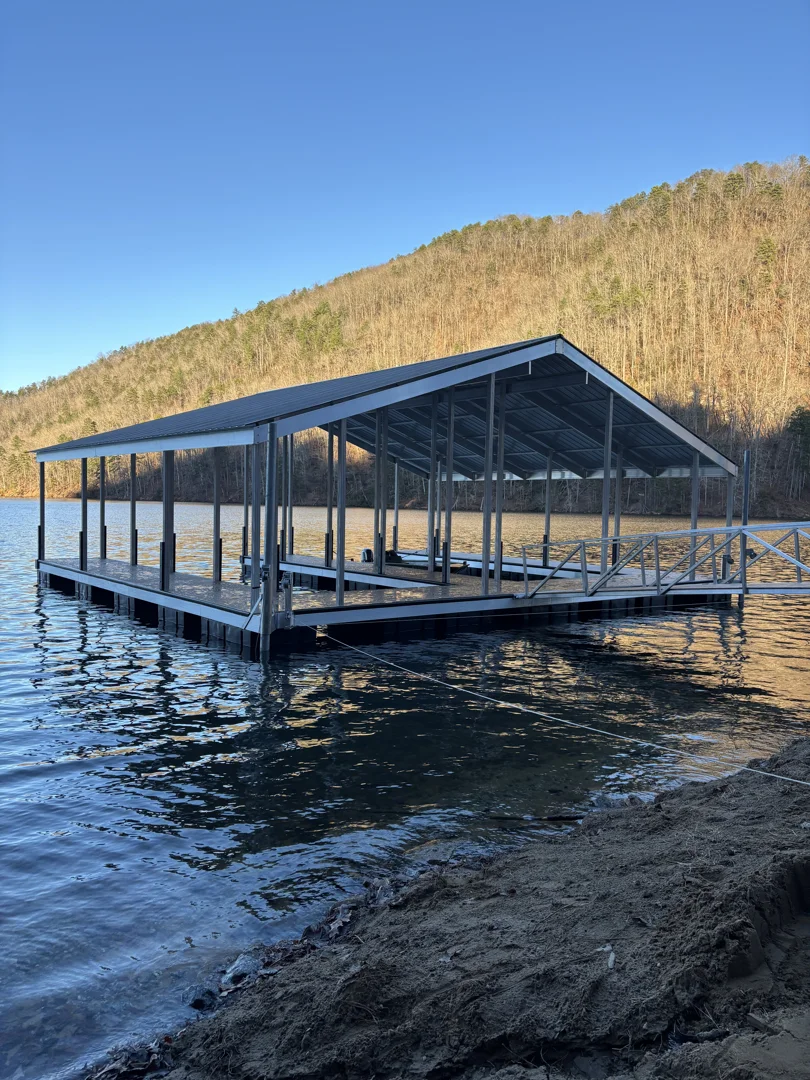
Gainesville floating dock experts are the right choice for any lakefront property owner on Lake Lanier or the surrounding North Georgia lakes. For over 70 years, Martin Docks has been the trusted name in the region, with thousands of aluminum docks installed across North Georgia since 1956.
Owning a lakefront property in Gainesville is a genuine privilege. But keeping your dock safe, functional, and looking great? That takes real work — and the wrong contractor can cost you thousands.
Lake Lanier is not a simple lake to build on. Water levels fluctuate significantly throughout the year. Shorelines erode. Permitting through the U.S. Army Corps of Engineers adds another layer of complexity. A local expert who knows these conditions makes all the difference.
Martin Docks has been building custom aluminum docks in this region since 1956 — three generations of hands-on knowledge about North Georgia lakes. That kind of deep local experience is hard to replicate.
Whether you need a brand-new floating dock, a full repair, or help protecting your shoreline from erosion, this guide walks you through everything you need to know before starting your next dock project.
When you are looking to build a structure that sits in water 365 days a year, material choice isn’t just a matter of aesthetics—it’s a matter of survival. Gainesville floating dock experts almost universally recommend high-grade aluminum systems for our local waterways, and for good reason.
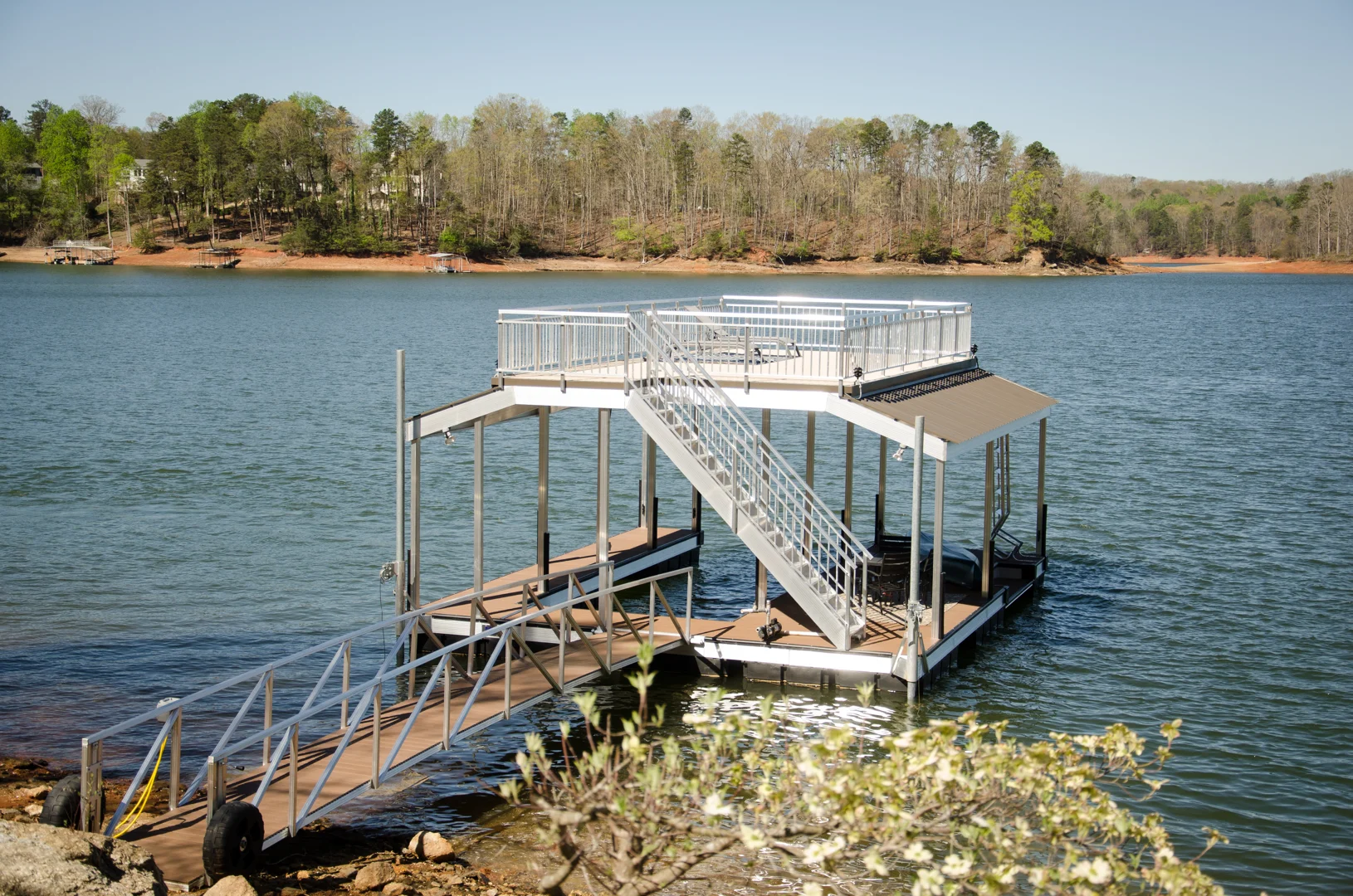
Aluminum is the “Goldilocks” of marine construction. It’s lightweight enough to float effortlessly but strong enough to withstand the heavy wake of a passing boat or a summer storm on Lake Lanier. Unlike wood, which eventually rots, warps, or invites splinters, aluminum is naturally corrosion-resistant. It doesn’t rust like steel, and it doesn’t require the constant staining or sealing that keeps you away from your actual lake time.
At Martin Docks, we’ve pioneered heavy-framed aluminum designs because we know they last for generations. Our systems are engineered to be low-maintenance, meaning your primary “work” involves little more than an occasional spray with a hose.
Customization is another huge benefit of aluminum. You aren’t stuck with a “one-size-fits-all” look. We offer 19 different roofing color options to ensure your dock matches your home’s aesthetic or your personal style. Whether you want a classic forest green or a modern slate grey, the finish is designed to withstand the harsh Southern sun without fading. If you’re curious about the different layouts and finishes available, you can find more info about custom dock options to see how we blend engineering with craftsmanship.
If you’ve lived in Gainesville for more than a season, you know that Lake Lanier is a bit of a “moving target.” Between seasonal drawdowns and heavy rainfall, the shoreline you have today might be 20 feet further out (or in) next month.
This is precisely why floating docks are the gold standard for North Georgia. A stationary dock is a permanent fixture; if the water drops, your boat is sitting in the red clay. If the water rises too high, your walkway is submerged. Floating docks, however, rise and fall with the tides of the lake, ensuring your boat is always accessible.
However, a floating dock is only as good as its anchoring system and the team managing it. Gainesville floating dock experts provide essential dock moving services to keep your investment safe. When the water recedes, the dock must be “pushed out” to prevent it from grounding, which can damage the flotation or the frame. Conversely, when the lake is full, the dock needs to be pulled in and the cables adjusted.
We understand the unique shoreline conditions of Hall County. We use specialized winch and cable systems that allow for easy adjustments. For homeowners who don’t want to spend their weekends checking water gauges, we even offer monitoring services to handle the heavy lifting for you.
Building the dock is just the beginning. To truly enjoy lake life, you need a partner who offers a full suite of marine services.
Every shoreline is different. Some are steep and rocky; others are shallow and sandy. We use advanced 3D modeling to help you visualize your project before a single piece of aluminum is cut. This allows us to tailor floor plans to your specific needs—whether that’s a massive sundeck for entertaining, a double-slip layout for multiple vessels, or a specialized gangway to handle extreme topography.
Engineering is where we really shine. We analyze the “fetch” (the distance wind can travel across open water to hit your dock) to ensure your anchors and frame can handle the pressure. We also integrate boat lift systems directly into the design, ensuring the weight is distributed perfectly.
Even the toughest docks need a little TLC eventually. Exposure to the elements year-round means hardware can loosen, and older decking might need a refresh. We specialize in “refloats” (replacing old foam or plastic tubs), structural welding for frame repairs, and redecking.
Many Gainesville, Ga residents are choosing to swap out old wood decking for modern composites or concrete pavers. These materials are cooler on the feet and last much longer. We also provide professional pressure washing to keep your dock looking brand new. You can find more info about dock repair services to see how we can extend the life of your existing structure.
Your dock is only as stable as the land it’s attached to. Erosion is a major issue on Lake Lanier, where boat wakes constantly “eat” away at the red clay banks. We provide shoreline stabilization using rip-rap (carefully placed stones) to prevent land loss.
Beyond the physical work, we handle the headache of U.S. Army Corps of Engineers (USACE) compliance. Every dock on Lake Lanier requires a permit, and the rules are strict regarding size, location, and even the type of power you can run to the water. We conduct site assessments and review property history to ensure your project is 100% legal and protected.
A dock is a platform for fun, and the right accessories make that fun much easier to access.
Boat lifts are the single best way to protect your vessel. By keeping your boat out of the water when not in use, you prevent hull staining, algae growth, and the constant “banging” against the dock during storms. Most modern lifts can launch or dock your boat in about three minutes—no more struggling with trailers at a crowded public ramp.
For those with smaller watercraft, PWC ports (jet ski docks) are a game-changer. These modular “drive-on” ramps make it incredibly easy to jump on your ski and go. You can find more info about PWC ports to see how they integrate into your current layout.
We also focus on the “little things” that make a big difference:
With so many companies claiming to be experts, how do you choose? It comes down to two things: history and reliability.
In the dock business, experience isn’t just a number—it’s a survival rate. Companies that don’t build quality docks don’t last 70 years. At Martin Docks, we are a third-generation family business. We’ve seen every drought and every flood Lake Lanier has had since it was created.
When evaluating Gainesville floating dock experts, look for:
The U.S. Army Corps of Engineers manages Lake Lanier, and they take their job very seriously. You cannot simply build whatever you want. There are limits on “square footage of over-water coverage” and specific requirements for anchoring.
We act as your liaison. We handle the site history reviews and physical property checks required for permit renewals or new installations. We also offer a “Dock Watch” program. Because the Corps requires docks to be kept in navigable water, our dock monitoring service ensures your dock stays in a legal, safe position even when you aren’t at the lake.
Stationary docks are fixed at one height. Because Lake Lanier’s water levels can drop 10 to 20 feet during a drought, a stationary dock can quickly become a “land dock,” leaving your boat stranded. Floating docks stay on the water’s surface regardless of the level, ensuring you always have access to your boat.
We recommend a thorough inspection at least once a year, ideally in the spring before the heavy boating season begins. We check for loose bolts, worn winch cables, structural cracks in the aluminum, and the integrity of the flotation tubs. Regular maintenance is much cheaper than an emergency repair!
Rip-rap is a layer of large stones placed along the shoreline. It acts as armor against erosion caused by waves and boat wakes. Without it, the red clay banks of Lake Lanier will slowly wash away, which can eventually destabilize your dock’s land-side anchors and destroy your landscaping.
Your dock is more than just a place to tie up a boat; it’s the gateway to your lifestyle. It’s where your kids learn to fish, where you host summer BBQs, and where you find peace at the end of a long day.
For over 70 years, Martin Docks has been the trusted name for North Georgia and Western North Carolina lakes. With three generations of experience and a commitment to precision-built aluminum systems, we know exactly what it takes to make “lake life” easy. From Lake Lanier to Lake Blue Ridge and everywhere in between, we are here to ensure your waterfront investment lasts for decades to come.
Ready to start your next project or need an expert eye on your current dock? Contact the Gainesville floating dock experts today for a consultation. Let us help you build something that lasts.